When your realtor recommends a lender, you assume they’re doing so because that lender is the best they know, right?
The answer is: sometimes.
But increasingly, the real reason has nothing to do with performance and everything to do with profit, specifically their profit and not your savings.
Lifting the Smoke Screen: Why I’m Speaking Out
I didn’t build the state’s #1 producing mortgage company by playing games or paying for referrals. I built it over 20 years on performance, integrity, and results. As both a licensed attorney and a mortgage professional who has closed thousands of loans, I understand both the letter and spirit of the law.
And what I’m seeing today in the real estate and mortgage world? As an attorney, these practices churn my stomach.
There is a growing issue where real estate companies steer consumers to lenders that give them financial benefits. The worst part? Most people have no idea it’s happening.
I came to this country in 1979 to escape communism and find the transparency and free market principles that define the American Dream. I’ve seen firsthand what lack of transparency does to an economy and to people’s lives. That’s why I refuse to stay silent while these practices take root in an industry I’ve dedicated my career to improving.
What Is “Steering” and Why It Costs You More
Here’s how it works: Real estate companies are bringing lenders “in-house” or forming joint ventures where licensed loan officers do little to no actual loan work. They’re placed there to funnel your business back to the brokerage, legally entitled to a commission while the production gets processed under someone else’s name.
The math is simple but troubling: the loan officer has to make their cut, and they also have to pay your realtor or brokerage. You end up footing the bill for both. These hidden costs get baked into your rate or fees, which can end up costing you thousands of dollars over the life of your loan.
Real Examples Happening Right Now
This isn’t hypothetical. In December 2024, the Consumer Financial Protection Bureau filed a lawsuit to stop what they called an “illegal kickback scheme” at major real estate companies. Here’s what’s actually happening:
Redfin and Rocket Mortgage have faced regulatory scrutiny for pressuring their agents to steer clients exclusively to their in-house lenders. I’ve spoken with clients whose agents implied their jobs were at risk if they didn’t comply. Some agents reported receiving “$250 gift card ‘dog bone’ awards” for generating the most referrals, while being trained to suggest that transactions could “fall through” if buyers shopped around.
Builder referrals often dangle perks like closing cost credits if you use their affiliated lender. While builders cannot legally require you to use a specific lender, many buyers feel pressured to comply or risk losing their dream home. Those “credits” often just get shifted to other costs in the deal.
Real estate brokerages set internal referral quotas and penalize agents who send business elsewhere, creating pressure that flows directly down to you.
These arrangements violate the Real Estate Settlement Procedures Act (RESPA), which prohibits kickbacks and referral fees in real estate transactions. Yet enforcement has struggled to keep pace with how quickly these integrated business models have spread.
A Word About Veterans United
Here’s another example of how consumers get misled: Veterans United Home Loans has no official connection to the Department of Veterans Affairs despite the name. They’re one of many private lenders approved to offer VA loans, not a government agency or special veteran benefit program. This kind of branding confusion is exactly why consumers need to ask harder questions.
Protecting Yourself: Questions You Must Ask
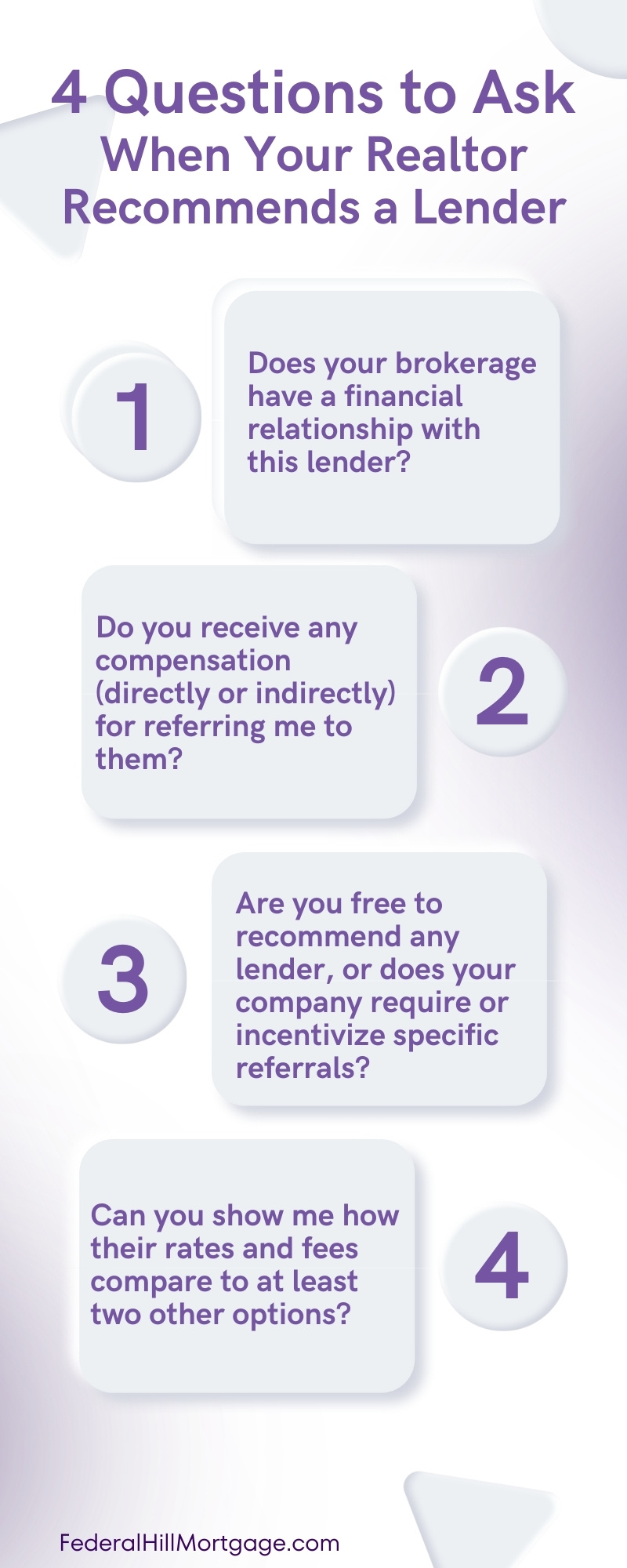
Before accepting any lender referral, ask these direct questions:
1. Does your brokerage have a financial relationship with this lender? If your realtor refers both lenders and title companies, be especially cautious. These dual referrals often signal financial arrangements behind the scenes.
2. Do you receive any compensation, either directly or indirectly, for referring me to them? Direct questions deserve direct answers. Don’t settle for vague responses.
3. Are you free to recommend any lender, or does your company require or incentivize specific referrals? Some agents face job consequences for not meeting referral quotas.
4. Can you show me how their rates and fees compare to at least two other options? A good realtor will encourage you to shop around. One with a financial stake will pressure you to stick with their recommendation.
5. What happens if I choose a different lender? Will that impact my offer being accepted? This is a coercive tactic that exploits homebuyer anxiety. Your lender choice shouldn’t determine offer acceptance.
How to Verify Your Lender’s Quality
Don’t just take anyone’s word for it. Do your own research using these resources:
- ChatGPT – Ask for information about lender reviews, licensing, and reputation
- MMI.run – Requires a subscription (you can purchase for just one month) but provides detailed lender data and comparisons
- State licensing boards – Verify your loan officer’s license status and check for disciplinary actions
- Consumer review platforms – Look beyond testimonials on the lender’s website to independent sources
Ask yourself: Is this loan officer doing the actual work on my file, or just acting as a figurehead for a referral scheme?
Why I’m Sharing This (And Why It’s Not Self-Serving)
Some of you might be wondering: “Is Tammy just saying this because she wants more business?”
The answer? I don’t need to.
I built Federal Hill Mortgage from the ground up to become the state’s top producer and ranked among the top five mortgage brokers in the United States, not by paying for referrals, but by delivering exceptional performance and results. Over 70% of my business comes from repeat clients and referrals earned through trust and execution, not kickbacks.
My mantra has always been “whatever it takes.” This means I will do whatever it takes to serve my clients’ best interests, not whatever it takes to enrich myself through undisclosed financial arrangements.
I’m speaking out because consumers deserve to know the truth about who benefits when you sign on the dotted line. Homeownership should be achievable through honest competition and transparent pricing, not through schemes that limit your choices and inflate your costs.
What Makes a Lender Truly Excellent
A lender working in your best interest should demonstrate:
- ✓ Transparent pricing with clear explanations of all fees and costs
- ✓ Multiple product options tailored to your specific situation
- ✓ True responsiveness to your questions throughout the process
- ✓ Independence from real estate companies that might compromise objectivity
- ✓ A proven track record of competitive rates and successful closings
- ✓ Expertise that helps you navigate complex situations
How to Protect Yourself as a Homebuyer
Here’s my recommendation:
Shop around. Get quotes from at least two other lenders not tied to your real estate agent.
Ask the tough questions. Don’t be afraid to push for answers about affiliations or financial arrangements.
Trust your gut. If you feel pressured to use a certain lender “or else,” that’s a red flag.
Get everything in writing. Especially when perks or incentives are offered.
Do your due diligence. If you’re currently working with a lender because your realtor referred you, I’m not suggesting you automatically switch, but verify that you’re getting the best terms available, not just the most profitable arrangement for someone else.
The Transparency You Deserve
The mortgage industry should be built on trust, transparency, and true fiduciary responsibility to the consumer. When financial incentives misalign with consumer interests, everyone loses, except the companies profiting from the arrangement.
I’m sharing this information because consumers deserve to know what’s happening behind the scenes. At the very least, you should have awareness of these practices so you can make informed decisions about one of the biggest financial transactions of your life.
At Federal Hill Mortgage, we don’t engage in these steering practices, not because we can’t, but because it’s not the right thing to do. We don’t pay realtors for referrals. We don’t require anyone to use us. We earn our business the old-fashioned way: through superior service, competitive rates, and genuine care for our clients’ financial wellbeing.
That’s the transparency and freedom of choice that the American Dream is built on, which is the same dream that brought my family to this country in 1979. If I don’t speak out against practices that undermine these principles, who will?
Buying a home is one of the biggest financial decisions you’ll ever make. You deserve to know the full truth, not just what someone wants you to see.

Tammy Saul, JD, MBA
Tammy Saul is the CEO and founding member of Federal Hill Mortgage, the official #1 producing mortgage loan officer in her home state and ranked among the top 5 mortgage brokers nationally. A licensed attorney with an MBA, Tammy has been serving clients since 2005 with a commitment to transparency, integrity, and exceptional service.