Homebuying Power Is Up $36,600 in 2026 — Here’s What That Means

Homebuying_Power

In 2026, the typical buyer has $36,600 more homebuying power than they did a year ago. Here’s why that matters, and how to use it strategically.

According to the First American Real House Price Index, this gain didn’t come from one dramatic shift—it came from two things finally moving in buyers’ favor at the same time.

Where the Extra $36,600 Came From

This is not a story about home prices crashing. It’s a story about income growth and lower mortgage rates combining to change what options are realistic for buyers.

FactorAmountSource
Income Growth+$13,100First American (3.6% wage growth YoY)
Lower Mortgage Rates+$23,500First American (0.57% rate drop YoY)
Total Buying Power Gain$36,600Combined effect

What This Breakdown Means

Annual private-sector hourly wage growth increased 3.6% compared with a year earlier, boosting median household income by 3.5% year-over-year. That income growth alone increased buying power by roughly $13,100.

Mortgage rates were 0.57 percentage points lower than a year earlier, lifting purchasing power by approximately $23,500. Combined, these two forces gave typical buyers about $36,600 more house-buying power.

Why It Still Feels Hard (And Why That Matters)

Here’s the part most headlines skip.

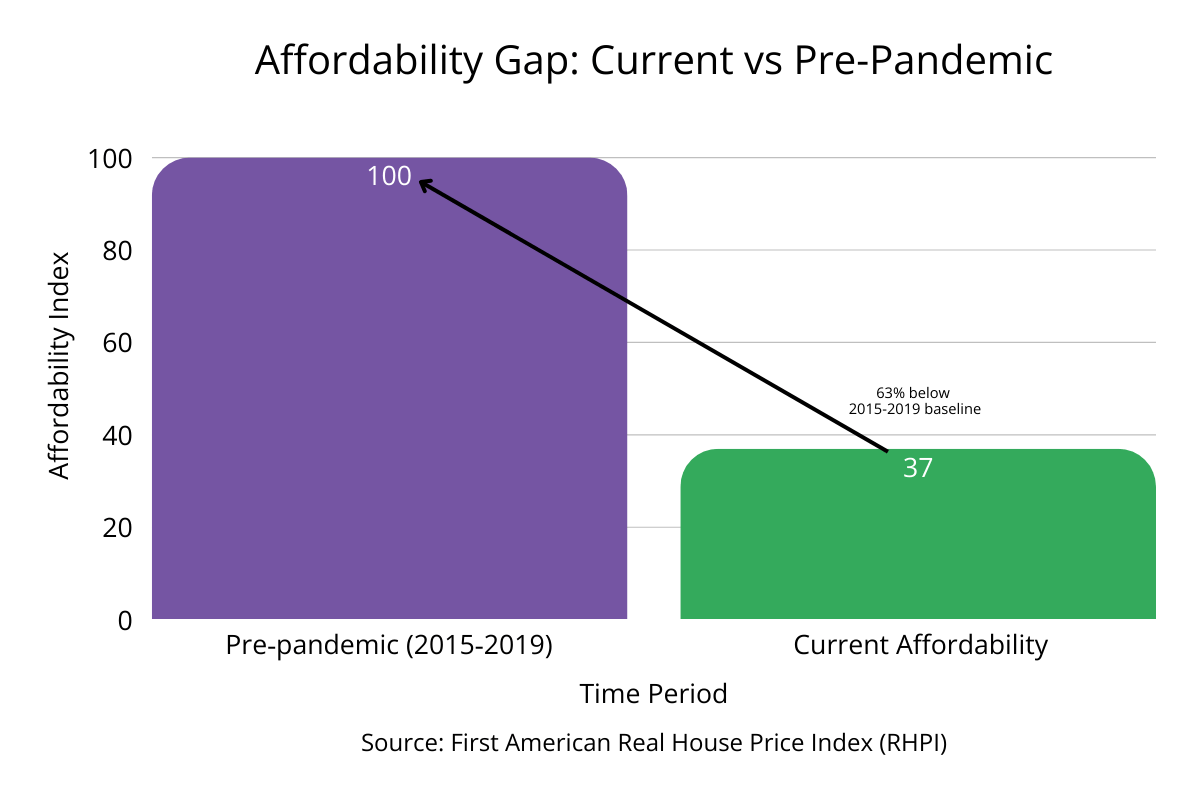
First American also says affordability is still more than 63% below its pre-pandemic five-year average (based on their index methodology).

Bar chart showing current housing affordability remains 63% below pre-pandemic levels

So yes, housing affordability 2026 is better than 2025. But we’re still in a market where strategy matters. Understanding your real monthly payment comfort zone and your DTI ratio—how much of your income goes to housing debt—is just as important as knowing your maximum buying power.

How Rising Homebuying Power Changes Your Buyer Options in 2026

An extra $36,600 can show up in different ways depending on your situation and your local market.

1) You May Have More “Acceptable Homes,” Not Just More Homes

A lot of buyers aren’t trying to maximize purchase price. They’re trying to avoid regret.

That extra buying power can mean moving from:

  • “Only homes that need major work” → “Move-in ready options that cost slightly more”
  • “One neighborhood that barely fits the budget” → “A wider radius with better inventory”

When you ask “how much house can I afford in 2026?”, the answer isn’t just a price—it’s access to better options and more breathing room in your monthly payment.

2) Negotiation Leverage Is Back

Even with affordability improving, buyers aren’t rushing like they did during the frenzy.

Redfin data shows:

  • Homes took a median 63 days to go under contract
  • Only 19.2% sold above list
  • Average sale-to-list ratio: 97.7%

That combination signals a more normal market where sellers have to compete. It’s why smart buyers are now focusing on negotiation leverage and terms, not just trying to win a price war.
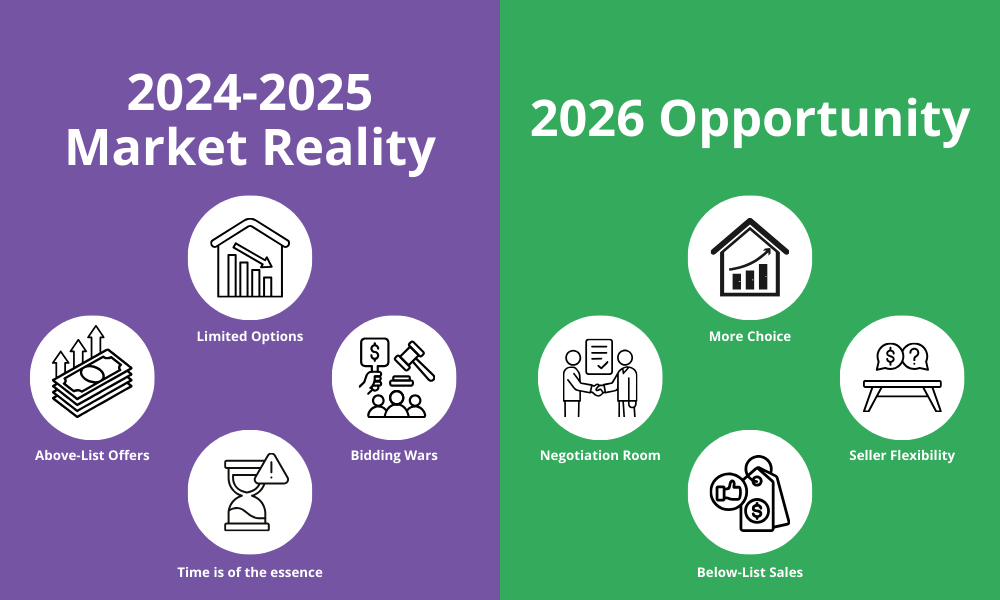
Comparison of buyer leverage between 2025 and 2026 housing markets

3) Concessions Can Matter More Than a Lower Price

In a buyer-friendlier market, sellers often consider:

  • Repair credits (if inspection reveals issues)
  • Closing cost assistance (reduces cash needed at closing)
  • Rate buydowns (lowers your monthly payment in early years)
  • Flexibility on timing and contingencies (gives you breathing room)

The key: ask for concessions that improve your financial outcome. A well-targeted $10K credit for repairs might reduce your monthly payment more than shaving $20K off the purchase price. Learn more about closing cost assistance options available to you.

4) Build an Offer Strategy Instead of Guessing

When markets are tight, buyers often have one move: go higher.

When markets slow down, you can build a strategy around:

  • Which homes are overpriced and likely to negotiate
  • Which sellers are motivated by timeline (and will trade price for certainty)
  • Which concessions actually help you close smoothly

This is where working with a lender who can run scenarios quickly helps. You can respond with confidence instead of emotion.


When Should You Act on Improved Buying Power?

Here’s the commercial reality: improved affordability doesn’t mean waiting becomes smarter.

The case for acting now:

  • Homes are sitting longer (63 days median), giving you time to find the right property without rushing
  • Fewer homes selling above list means less bidding war pressure
  • Seller motivation has shifted—price reductions and concessions are possible
  • Rates are down 0.57% from a year ago, but there’s no guarantee they stay there or go lower

The case for waiting:

  • If you’re waiting for rates to drop another full percentage point, current market data doesn’t support that timeline
  • Mortgage rate stability is often more valuable than chasing another 0.25% drop
  • Missing the right home for a potential rate improvement rarely pays off

The decision: If you’ve found a home that fits your budget and your life plans, acting now usually beats waiting. Get preapproved today to see what mortgage programs you qualify for and take the next step—with no hard credit pull required.

How Improved Mortgage Affordability Affects Sellers (And Why Buyers Should Care)

More buying power brings more buyers back into the market, but it also raises the bar for sellers.

If homes are sitting longer and fewer are selling above list, sellers who price based on peak-era expectations can get stuck.

Buyers benefit from that because it creates opportunities:

  • Price reductions (sellers adjust to market reality)
  • Credits and concessions (sellers compete with incentives)
  • Cleaner negotiations (less adversarial, more problem-solving)

Sellers who understand this are already adjusting their strategies. That’s good news for buyers with the right offer approach.

The Market Is Improving, But It’s Still “Plan First” Season

Here’s the most useful takeaway:

Affordability is improving because income growth and lower rates have stopped working against buyers at the same time. But inventory and pricing behavior vary wildly by location, and affordability is still far from pre-pandemic norms.

That means the winners in 2026 are buyers who do two things:

  1. Get clear on your real monthly comfort zone (not just your maximum buying power)
  2. Get ready to move when the right home and terms show up (don’t wait for perfection)

For first-time homebuyers, this market is actually more forgiving than it’s been in years. For move-up buyers, it’s an opportunity to negotiate from a position of strength.

Curious How Much Home You Can Afford in 2026?

Let us calculate your homebuying power based on real numbers—your income, credit, down payment, and current rates.

Here’s what you’ll get:

  • Custom estimate based on your specific financial situation
  • Realistic price range for your area and DTI ratio
  • Monthly payment scenarios so you know exactly what you’re comfortable with
  • No hard credit pull required with our soft-pull pre-qualification

Or reach out directly:

FAQ: Homebuying Power & Affordability in 2026

  • Homebuying power is an estimate of how much home you can afford based on your income, credit, down payment, and current mortgage rates. It’s different from your actual comfort zone—you might qualify to borrow $400K but only feel comfortable with a $350K monthly payment.

  • Two main reasons: (1) Income growth—annual wage growth of 3.6% added $13,100 to buying power, and (2) Lower rates—0.57% rate drop added $23,500 to buying power. Combined, that’s $36,600 more purchasing power per typical buyer.

  • Because affordability improved relative to incomes and rates, not absolute prices. A $400K home is still expensive in absolute terms, even if you can now afford a slightly higher price. The improvement means better options and more negotiating room—not that homes became cheap.

  • Yes, in most markets. Longer contract times (63 days median), fewer homes selling above list (19.2%), and seller motivation shifts create more negotiation room on price and terms.

  • That depends on your situation. If you’ve found a home that fits your budget and life plans, waiting for rates to potentially drop another 0.5% could mean missing the right property. Mortgage rate stability is often more valuable than chasing further drops.

  • A rate buydown temporarily reduces your mortgage rate for a set period (e.g., 3-2-1 buydown: 3% below market year one, 2% below year two, 1% below year three). This lowers your monthly payment in early years, which might allow you to qualify for a higher loan amount. However, the benefit is temporary, so lenders carefully underwrite these.

  • Buying power = what you can borrow based on your income and debt obligations. Affordability = what you can comfortably pay month-to-month while covering other expenses. Always prioritize comfort over maximum buying power.

  • Your personal buying power depends on: gross monthly income, existing debt, down payment amount, credit score, and current mortgage rates. Use our soft-pull pre-qualification tool or contact us to run your specific numbers.

  • Ask for concessions that directly reduce your cost of ownership or improve your timeline: repair credits (if inspection reveals issues), closing cost assistance (reduces cash needed at close), rate buydowns (lowers early payments), or flexibility on closing date (helps you sell your current home).

  • DTI (debt-to-income ratio) is the percentage of your gross monthly income that goes to housing debt and other debts. Most lenders want to see DTI below 43%. Understanding your DTI helps you know your realistic buying power and monthly payment comfort zone.

About the Author

Picture of Tammy Saul, JD, MBA

Tammy Saul, JD, MBA

This article was written by the team at Federal Hill Mortgage, led by Tammy Saul, JD, MBA—CEO and the #1 producing female loan officer in the United States for units (2026). As Maryland's top-ranked loan officer since 2023, Tammy brings over 20 years of expertise in complex mortgage scenarios, including FHA loans, 3-2-1 rate buydowns, construction lending, and solutions for self-employed and high-net-worth clients. With legal training and an MBA, she approaches each transaction with strategic precision, helping buyers across MD, DE, PA, VA, DC, NC, TX, and FL understand their true buying power and navigate financing strategies tailored to their unique situations.
Individual NMLS #175722 | Company NMLS #176351

Facebook
Twitter
LinkedIn
Picture of Federal Hill Mortgage

Federal Hill Mortgage

The Federal Hill Mortgage Team is here to supply you with all the information you need to shop for a mortgage that's right for you.